

A 1:15 or 1:17 V60: What Changes in the Cup? Pour Over Coffee Ratio Explained
The best pour over coffee ratio depends on what you want in the cup and which variable needs adjusting. With a 20-gram V60 dose, 300 grams of water at 1:15 makes a more concentrated brew than 340 grams at 1:17, but concentration and extraction are not the same thing.
Key Takeaways
- Read the ratio as coffee to water by weight. For 20 grams of coffee, 1:15 calls for 300 grams of water; 1:17 calls for 340 grams.
- Use 1:16 as a middle starting point. That’s 320 grams of water for 20 grams of coffee — a common baseline before you adjust for taste.
- Change ratio to adjust strength. If the coffee tastes balanced but too concentrated or too light, adjust the water while keeping grind and pouring steady.
- Change grind or pouring to adjust extraction. Sour or bitter flavors usually point to an extraction problem, which adding or removing water alone won’t fix.
- For a 12-ounce water dose, use about 22 grams of coffee at 1:16. That amount is based on water added, not the finished drink.
- Keep a simple brew log. Write down coffee dose, water weight, grind setting, and drawdown time so each cup gives you a useful signal for the next one.
Read the pour over coffee ratio before you brew
Read 1:15 as one part coffee to 15 parts water by weight, not the other way around. With 20 grams of coffee, multiply 20 by 15 to get 300 grams of water; at 1:17, multiply 20 by 17 to get 340 grams.
For a middle starting point, use 1:16: 20 grams of coffee to 320 grams of water. Most V60 recipes land somewhere in the 1:15–1:17 band — tighter for a bolder cup, looser for something lighter and closer to tea.
A lower second number makes a more concentrated cup. A higher one makes it lighter. Try 1:15 when you want more intensity, or 1:17 when you want a gentler cup, then taste before you touch grind size or pouring.
What 300 g versus 340 g of water changes
With the same 20-gram dose, 300 grams of water makes a stronger-tasting brew than 340 grams. If both brews pull the same amount of dissolved coffee solids, the extra 40 grams of water at 1:17 works out to roughly 12% lower concentration than at 1:15.
More water gives the grounds more solvent and may increase extraction — but the ratio mainly changes beverage strength. It doesn’t automatically make the cup sweeter or less bitter. That depends on how the coffee actually extracts, which is a separate variable.
If the 1:17 cup tastes thin but otherwise balanced, use less water next time. If it tastes sour or harsh, look at grind and pour technique instead of assuming the ratio is the problem.
That distinction is the heart of dialing in a V60. Strength describes how concentrated the drink is. Extraction describes how much soluble material the water pulled from the grounds. Keep those two signals separate, and every recipe change gets easier to read.
Calculate a dose for the water you have
To find a coffee dose, divide your water weight by the ratio’s second number. For 473 grams of water, 1:15 takes about 31.5 grams of coffee, 1:16 takes about 29.6 grams, and 1:17 takes about 27.8 grams.
The table below shows water added, not the weight of the finished beverage — the grounds hold onto some water, so what you pour out weighs less than what you poured in.
| Water added | Approx. US volume | Coffee at 1:15 | Coffee at 1:16 | Coffee at 1:17 | Approx. tablespoons at 1:16 |
|---|---|---|---|---|---|
| 237 g | 8 fl oz | 15.8 g | 14.8 g | 13.9 g | 3 |
| 355 g | 12 fl oz | 23.7 g | 22.2 g | 20.9 g | 5 |
| 473 g | 16 fl oz | 31.5 g | 29.6 g | 27.8 g | 6 |
A tablespoon gives you a rough volume estimate, but spoon size and coffee density vary enough that it’s only a starting point. For a dose that actually repeats, use a coffee scale instead.
A scale also makes the recipe easy to resize: pick your water amount, divide by the ratio, weigh both ingredients. The math stays the same whether you’re brewing one small cup or a full carafe.
Adjust ratio for strength, grind for extraction
If the cup tastes balanced but too strong or too weak, leave the grind and pour alone and adjust the ratio instead. Change one variable at a time — it’s the only way to know which adjustment actually did something.
- Sour: Try a finer grind. It slows drawdown and tends to raise extraction.
- Bitter or drying: Try a coarser grind to pull extraction back down, then taste again.
- Weak and sour at the same time: Don’t just add more coffee. “Weak” is about concentration; “sour” usually points to under-extraction. Fix the grind or pour first, then judge strength on its own.
Hold water temperature and pouring steady while you work through this. Change ratio, grind, and temperature all in the same brew, and you won’t be able to tell which one moved the needle.
Treat the pour-over recipe as a small set of levers: dose, water, grind, temperature, pour. Jot a quick note for each brew — dose, water, grind setting, rough taste — and move one lever per cup. That’s the difference between guessing and actually dialing something in. If your beans came from an anaerobic-processed lot, the same one-variable-at-a-time approach applies; the starting ratio just needs its own round of tasting.
Set up the V60 and prepare the filter
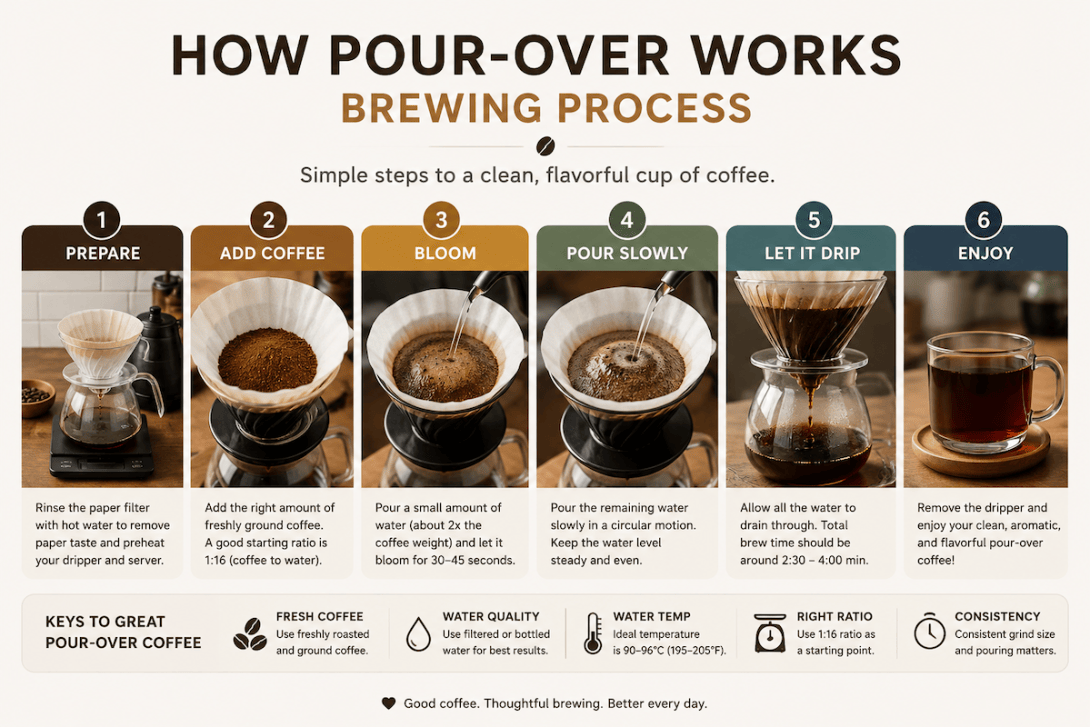
Use a scale to weigh both coffee and water, a paper filter, and a kettle with a narrow spout for a controlled pour. A gooseneck kettle makes it easier to place water evenly across the coffee bed instead of dumping it in one spot.
Rinse the paper filter with hot water before adding coffee. This cuts down on papery taste and warms the dripper and server; pour the rinse water out so it doesn’t throw off your measured recipe.
Start with a medium-fine grind and water in the 90–96°C (195–205°F) range — a common target for pour-over generally. For a light roast specifically, our light roast brewing temperature guide covers why the hotter end of that range tends to work better.
Aim for a consistent total brew time rather than chasing one “correct” number. Most pour-over recipes land around 2–4 minutes of total contact time, but grind size, dose, and brewer shape all shift that window. For more on brewing fundamentals beyond ratio, see the National Coffee Association’s overview of pour-over brewing.

Bloom, pour, and scale the recipe carefully
Add the grounds to the rinsed filter, then pour roughly twice their weight in water to bloom. For 20 grams of coffee, that’s about 40 grams — enough to wet the bed evenly without flooding it.
After 30–45 seconds, once the grounds stop bubbling, pour the rest of your water slowly. Keep the stream controlled so it doesn’t dig channels through the bed or wash grounds up the filter wall.
When you scale up, keep the ratio the same but check that the larger bed and pour still suit the V60. A deeper bed drains differently, so don’t expect a four-cup brew to behave exactly like a one-cup recipe just because the ratio matches.
You can carry the same ratio into a different dripper as a starting point, but filter shape, bed depth, and drawdown will still shift the result. Make small adjustments, and taste each one before moving to the next.
Frequently Asked Questions
Can I use pre-ground coffee for a V60?
Yes. Choose a grind intended for filter brewing, and close the bag tightly between uses to limit exposure to air and moisture. Since you can’t adjust the grind after purchase, lean on water temperature and pouring routine when refining the recipe.
Does the roast level affect which ratio tastes best?
Yes. Roast level changes how easily coffee releases soluble material, so two coffees can taste different at the same ratio. Rather than assigning one fixed ratio to every roast, keep a baseline recipe and adjust by taste.
Can I brew a stronger V60 and dilute it with hot water afterward?
Yes. Adding hot water after brewing lowers the drink’s concentration without extracting more from the grounds. That’s useful when you want a larger, lighter cup from a concentrated brew, though the aroma and texture may differ from brewing all the water through the bed.
Why does water sometimes run around the edge of the V60 instead of through the coffee bed?
Water bypasses the grounds when the bed sits unevenly or the pour sends water straight down the filter wall. Keep the grounds level before brewing and aim the stream onto the coffee bed, not the exposed paper.
Should I count the bloom water in my total brew water?
Yes, include it in the recipe’s total water weight. If your target is 320 grams, the bloom water is part of that amount, and the remaining pour makes up the balance.
Conclusion
For a 20-gram V60 dose, 1:15 means 300 grams of water and a more concentrated cup; 1:17 means 340 grams and a lighter one. The pour-over ratio is your strength control — grind, pouring, and temperature shape extraction, so adjust whichever variable actually matches what you’re tasting.
Start at 1:16 if you want a neutral middle point, weigh every brew, and change one input at a time. That small habit turns each cup into a clear signal for the next one.