
Must-Have Barista Tools for Home Espresso

Upgrading your espresso machine is exciting, but the journey to café-quality coffee at home doesn’t stop there. The secret to consistently delicious espresso often lies in the small, specialized tools that surround your machine. Quality accessories give you control over the tiny variables that make a huge difference, turning a good shot into a great one. These tools help you improve consistency, enhance flavor, and streamline your entire brewing process.

Why Accessories Matter for Home Baristas

Have you ever wondered why your espresso shots taste different every time, even when using the same beans? The answer is often puck preparation. The way you distribute, tamp, and prepare your coffee grounds before pulling a shot is critical. Inconsistent pressure or an uneven coffee bed can lead to channeling, where water finds the path of least resistance and bypasses most of the grounds. This results in a sour, under-extracted shot.

The right barista tools solve this problem. They are designed to create a repeatable workflow that ensures your coffee puck is perfectly prepped every single time. By improving your consistency, you unlock better flavor and a more satisfying espresso experience.

Top Pick: Normcore V4 Coffee Tamper

After looking at countless tools on the market, one item consistently stands out for its blend of performance, price, and popularity among home baristas: the Normcore V4 Coffee Tamper. This isn’t just another accessory; it’s arguably the best espresso tamper for a home barista looking for an immediate upgrade.

The Normcore V4 is a spring-loaded tamper, which is its key feature. It is calibrated to provide consistent pressure every time you tamp. You simply press down until the tamper’s collar rests on the portafilter basket, and the internal spring ensures you’ve applied the correct force. This removes the guesswork, which is a game-changer for beginners.

Benefits of the Normcore V4:

  • Perfectly Level Tamping: The self-leveling design ensures your coffee bed is flat and even, drastically reducing the risk of channeling.
  • Consistent Pressure: The spring mechanism delivers the same amount of force with every use, taking the guesswork out of how hard to press.
  • Affordable Excellence: This is an affordable coffee tamper on Amazon that delivers performance comparable to much more expensive tools. It provides a high return on investment for improving your espresso.

This tamper is ideal for beginners who are still developing their tamping technique and intermediate users who want to add more consistency to their routine. This spring loaded espresso tamper review is simple: it works, it’s reliable, and it helps you make better coffee.

Other Essential Espresso Tools

Beyond the tamper, a few other accessories can elevate your home coffee bar from functional to fantastic.

Coffee Distributor

An espresso distributor tool, sometimes called a WDT tool or leveler, is used before tamping. Its job is to break up clumps and evenly distribute the coffee grounds in the portafilter. By creating a uniform density, you ensure water flows through the entire puck at the same rate, leading to a balanced extraction. Without it, you might have dense spots and empty pockets, which causes channeling.

Thermometer

Temperature is a critical variable for both your espresso shot and your steamed milk. An espresso thermometer helps you hit the sweet spot. For milk, steaming between 140-155°F (60-68°C) creates a sweet, creamy microfoam without scalding the milk. For brewing, checking your water temperature ensures it’s in the ideal range (typically 195-205°F or 90-96°C) for proper extraction.

Tamper Mat

A tamper mat for espresso is a simple but effective tool. This thick silicone or rubber mat provides a dedicated, non-slip surface for tamping. It serves two main purposes: it protects your countertop from scratches and dents from the heavy portafilter, and it stabilizes the portafilter, allowing you to apply firm, even pressure without it sliding around.

Knock Box

Once you’ve pulled your shot, you are left with a hot, wet puck of coffee grounds. An espresso knock box provides a clean and convenient way to dispose of it. It’s a small, sturdy container with a rubberized bar across the middle. You simply strike the portafilter against the bar, and the puck drops out cleanly. This keeps your trash can from getting messy and speeds up your workflow, especially if you’re making multiple drinks.

How to Use These Tools Together

Here is a step-by-step workflow incorporating these essential tools:

  1. Grind Your Beans: Start by grinding your coffee fresh into the portafilter.
  2. Distribute: Use your coffee distributor tool to break up any clumps and create a level surface.
  3. Tamp: Place your portafilter on the tamper mat. Use the Normcore V4 tamper to press down firmly until the spring fully compresses and the collar touches the basket.
  4. Pull Your Shot: Lock the portafilter into your machine and start the brewing process.
  5. Steam Milk (if needed): Use your thermometer to monitor the milk temperature as you steam it for a latte or cappuccino.
  6. Clean Up: After brewing, knock the used puck into your knock box for quick and easy disposal.

Buying Guide & Tips

When shopping for barista tools, keep these factors in mind:

  • Size: This is the most important consideration. Your tamper and distributor must match the diameter of your portafilter basket (e.g., 53.3mm, 58mm). Check your espresso machine’s manual for the correct size.
  • Material: Look for tools made from durable materials like stainless steel and food-grade silicone. They are easy to clean and built to last.
  • Ease of Cleaning: Accessories that come into contact with coffee grounds need regular cleaning. Choose items that are easy to rinse or disassemble.

FAQ

1. Do I really need a tamper mat?
While not strictly necessary, a tamper mat is highly recommended. It protects your counters from damage and provides the stability needed for a good, level tamp. For a small cost, it adds a lot of convenience and safety to your routine.

2. What size tamper fits my machine?
This depends entirely on your espresso machine’s brand and model. Common sizes are 51mm, 53mm, and 58mm. Always check your machine’s specifications before buying a tamper or distributor.

3. How often should I clean my knock box?
You should empty your knock box daily to prevent mold and odors. A quick rinse with water is usually sufficient, with a more thorough soap-and-water cleaning once a week.

Conclusion

Building a home espresso setup is a rewarding journey. While the machine is the star, accessories like the Normcore V4 tamper, a distributor, and a knock box are the supporting cast that ensures a flawless performance every time. These tools replace guesswork with precision, helping you pull consistently delicious shots you can be proud of. The Normcore tamper, in particular, is a fantastic starting point that delivers an immediate, noticeable improvement to your coffee.

Ready to take control of your espresso? Check the current prices for these essential home barista tools on Amazon and start your journey toward the perfect shot.

Specialty Coffee: A Complete Guide from Bean to Cup

Have you ever sipped a coffee so vibrant it made you stop and think? If so, you’ve tasted why so many people are obsessed with specialty coffee. This isn’t just a drink; it’s a movement focused on amazing quality, clear origins, and unique flavors that stand out from the average cup. For many, that first taste of a brew with notes of blueberry or jasmine is a “wow” moment. As a result, it can forever change how they see their morning ritual.

But what exactly makes a coffee a “specialty coffee”? It’s not just a fancy label. Instead, it shows a commitment to quality at every single step. This journey starts with the farmer and ends with the barista who brews your cup. This guide will pull back the curtain on the world of specialty coffee. Moreover, we’ll explain why it’s so different from what you find on most store shelves.

What is Specialty Coffee?

In simple terms, specialty coffee refers to coffee beans that score 80 points or higher on a 100-point scale. A certified coffee taster, known as a Q Grader, awards this score. A high score means the coffee has a distinct character and is free of major flaws. Erna Knutsen first used the term in 1974 to describe beans with unique flavors from special microclimates.

Unlike commercial coffee grown for mass production, specialty coffee celebrates uniqueness. Each batch tells the story of its origin—the soil, altitude, climate, and the people who grew it. In fact, you can often trace a bag of specialty beans to a single farm or cooperative. This transparency not only guarantees quality but also creates a fairer link between you and the coffee producers.

The Specialty Coffee Association (SCA)

The Specialty Coffee Association (SCA) is the main organization behind these high standards. The SCA is a global non-profit made up of coffee professionals, from farmers to baristas. They work to make coffee better by raising standards all over the world. To do this, they provide education, support research, and set the rules for coffee quality.

One of the SCA’s biggest contributions is its standard cupping protocol. This is the official process for tasting and scoring coffee. By creating a universal language, the SCA ensures that a score from a taster in Brazil means the same as one from a taster in Japan. Consequently, this gives the term “specialty coffee” its authority.

How Farmers Grow and Grade Specialty Coffee

The path to an amazing cup of coffee begins long before roasting. It all starts on the farm, where careful attention to detail is key.

Coffee-Growing Regions

Farmers typically grow specialty coffee in the “Bean Belt.” This is a region around the equator with high altitudes, rich soil, and stable climates. For example, countries like Ethiopia, Colombia, and Guatemala are famous for producing beans with complex flavors. The unique environment, or terroir, gives the coffee its distinct character, much like in wine production.

Harvesting and Processing

Unlike mass-market coffee, farmers usually hand-pick specialty coffee cherries. They select only the ripest, deep-red cherries to ensure the best sweetness and flavor. After harvesting, they process the cherries to remove the fruit and prepare the bean for drying. Some common methods include:

  • Washed: Workers scrub the fruit off before drying the bean. This process creates a clean, bright, and acidic cup.
  • Natural: They dry the whole cherry with the bean inside. This method gives the coffee fruity, sweet, and sometimes wine-like flavors.
  • Honey: Processors leave some of the fruit pulp on the bean while it dries. This creates a cup that balances the brightness of a washed coffee with the sweetness of a natural.

Grading Green Beans

Before roasting, experts grade the unroasted “green” beans. They inspect a sample for defects like insect damage or mold. To earn the specialty grade, a coffee must have zero major defects and very few minor defects. They also measure moisture content and bean size to ensure the beans will roast evenly.

Understanding the Cupping Score

So, how does a coffee earn the specialty label? The answer is a process called “cupping.” During a cupping, certified Q Graders analyze and score a coffee’s key attributes.

First, they evaluate several cups from the same batch to check for consistency. They smell the dry grounds, then the wet grounds. Afterward, they taste the coffee by slurping it to spray it across their palate. This technique helps them identify its flavor, aftertaste, acidity, body, and balance.

They score each attribute, and the final tally determines the coffee’s quality on a 100-point scale.

  • 80+ points: Qualifies as specialty coffee.
  • 85–89.99 points: Considered excellent.
  • 90–100 points: Outstanding and rare.

A high cupping score means a coffee is not only free of flaws but also has exceptional and pleasing qualities.

Criteria for Specialty Coffee

To truly understand specialty coffee, it helps to know the specific criteria tasters use.

Green Bean Quality

  • Defects: Specialty coffee allows for almost no major defects (like sour beans) and only a few minor defects (like broken beans).
  • Moisture Content: The ideal moisture level is between 10% and 12%. If it’s too dry, the bean loses flavor. On the other hand, if it’s too wet, it can develop mold.
  • Size & Uniformity: Workers sort the beans to a consistent size. This ensures they roast evenly.

Cup Quality

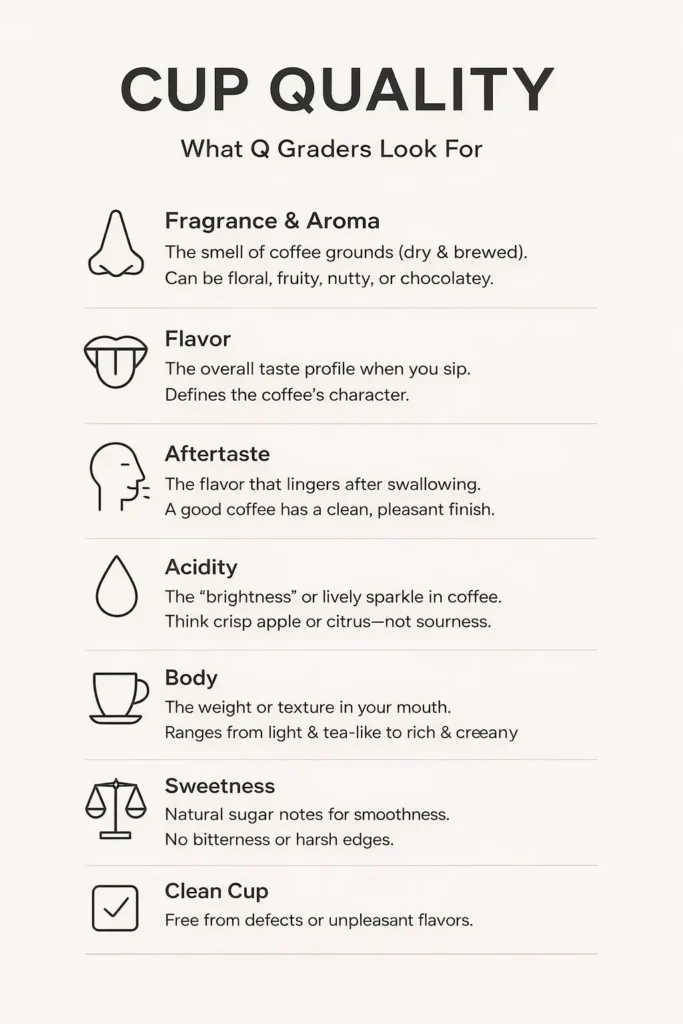
This is where the sensory experience truly matters. Q Graders look for:

  • Fragrance/Aroma: The smell of the coffee, both dry and wet.
  • Flavor: The main tastes you notice when you sip the coffee.
  • Aftertaste: The flavor that lingers after you swallow. A great coffee has a pleasant, clean finish.
  • Acidity: This is the “brightness” or “liveliness” in a coffee, not sourness.
  • Body: The weight or feel of the coffee in your mouth. It can be light and tea-like or heavy and creamy.
  • Balance: How well all the elements work together.
  • Sweetness: The natural sugars that create a smooth, pleasant taste.
  • Clean Cup: The absence of any distracting off-flavors.
  • Uniformity: Each cup from the same batch should taste the same.
Infographic showing cup quality criteria evaluated by Q Graders, including fragrance and aroma, flavor, aftertaste, acidity, body, sweetness, and clean cup.
Cup Quality: What Q Graders Look For
Key sensory attributes used by certified Q Graders to evaluate specialty coffee quality.

Traceability & Sustainability

Knowing where your coffee comes from is a core part of the specialty coffee movement. This includes:

  • Traceability: You can trace the coffee back to its origin, often to a single farm. This transparency guarantees authenticity.
  • Sustainability: This focuses on eco-friendly farming and paying farmers fair wages. When you buy specialty coffee, you often support a more ethical supply chain.

Top Specialty Coffee Tools & Beans We Love

How to Make Specialty Coffee at Home

Brewing specialty coffee at home is easier than you might think. With the right gear and a little practice, you can unlock incredible flavors.

Essential Gear

  • Quality Beans: Always start with freshly roasted whole beans from a trusted roaster.
  • Burr Grinder: This is the most important tool for better coffee. A burr grinder gives you a consistent grind size, which is key for even extraction.
  • Digital Scale: A good digital scale helps you measure your coffee and water accurately. As a result, you can repeat that perfect cup every day.
  • Brewer: Choose a method that fits your taste.

Brewing Methods

  • Pour-Over (e.g., Hario V60, Chemex): This method gives you total control. It makes a clean, bright cup that lets delicate flavors shine.
  • French Press: This immersion method creates a full-bodied, rich cup with a heavier mouthfeel because its filter allows more oils to pass through.
  • Espresso: An espresso machine makes a concentrated shot of coffee. It is the base for lattes but is also a great way to taste the intense flavors of a bean.

Premium Coffee vs. Specialty Coffee

You may see bags labeled “premium” or “gourmet” in the store. While these sound good, they are not the same as specialty coffee.

  • Premium Coffee: This is mostly a marketing term. It suggests higher quality, but there is no official standard to back it up.
  • Specialty Coffee: This is an official grade. A certified professional has scored it 80 points or higher based on strict protocols.

Essentially, a “premium” coffee might taste fine, but a specialty coffee will offer a complex and clean cup with distinct notes like lemon or peach. That clarity and depth are what set it apart.

Read about my experience tasting specialty coffee in Thailand.

Conclusion

Specialty coffee is more than a simple drink; it’s a craft that celebrates quality and human connection. It represents the best that coffee can be, thanks to the hard work of people from farm to cup. Now that you understand the criteria that define it, you can better appreciate the care in every bag.

Exploring specialty coffee is an exciting upgrade to your daily routine. You’ll discover a world of flavor you never knew existed.

If you want to start brewing specialty coffee at home, check out our recommended beans and gear to begin your flavor adventure today.